The hidden EU funds behind violence at sea
Topic
Country/Region
07 April 2026
In August 2025, the humanitarian vessel the Ocean Viking was shot at in international waters north of Libya. The attackers were part of what is known as the Libyan Coast Guard - a collection of militias and other actors funded by the EU to prevent irregular migration to Europe. A new report reveals the financial ties between the EU and the so-called Libyan Coast Guard. It also shows how, despite clear evidence of mass violence waged against migrants and humanitarians, the EU plans only to extend the cooperation.
Support our work: become a Friend of Statewatch from as little as £1/€1 per month.
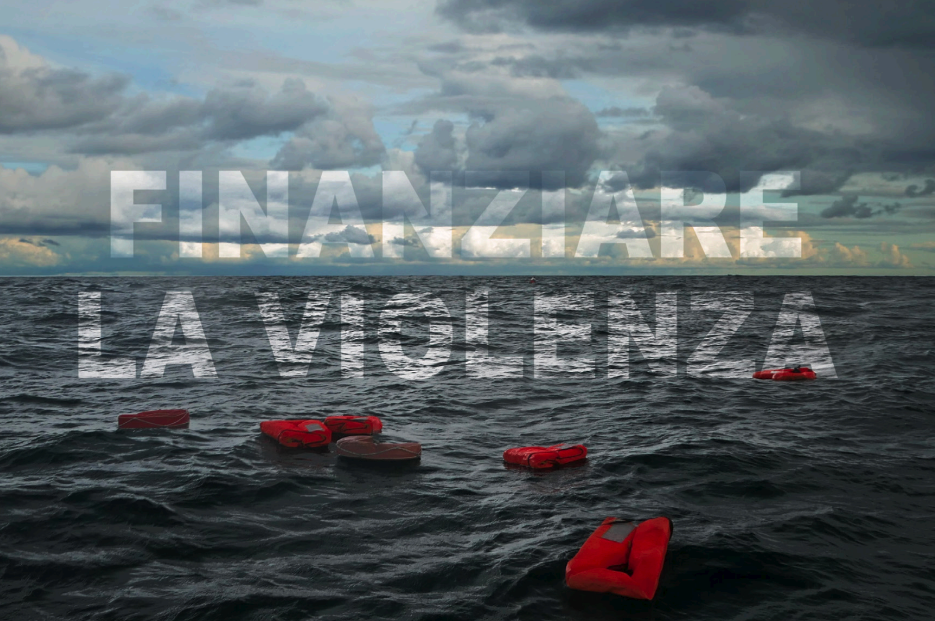
Written for Statewatch by journalist Lorenzo Bagnoli of IrpiMedia. The full report, "Financing the Violence", produced in collaboration with SOS Méditerranée, is available in Italian here.
Gunfire erupts without warning in international waters. Bullets strike a ship’s radar systems, disable four rescue dinghies and shatter the bridge’s protective glass. The crew scrambles to secure the 87 migrants on board, repeatedly demanding—first in English, then in Arabic—that the attack stop. To no avail.
This happened on August 24, 2025. The search-and-rescue vessel Ocean Viking, operated by the European NGO SOS Méditerranée, was hit by more than a hundred rounds over several minutes. Altogether it caused an estimated €194,000 in damage.
This was not an isolated incident. It is part of a growing pattern of violence by Libyan authorities at sea: at least 24 attacks against NGOs between 2021 and September 2025.
In a new report, “Funding the Violence”, produced with SOS Méditerranée, IrpiMedia has traced the origin of the funds that enabled the attack, starting with the boat: the Houn 664.
Donated by Italy to Tripoli with European funds, the Houn 664 enabled the so-called Libyan coast guard to carry out interceptions at sea. The funds stem from an EU programme known as SIBMMIL—Support to Integrated Border and Migration Management in Libya. Launched in 2017 and concluded last year, the programme was implemented by Italy’s Ministry of the Interior in cooperation with the International Organisation for Migration (IOM).
IrpiMedia also analysed documents from #MedSeaLeaks, a leak within the European mission EUNAVFOR MED IRINI. We cross-checked what EU institutions say publicly and privately about their collaboration with Libyan counterparts.
The money trail
The money trail of the SIBMMIL programme reveals a lack of transparency and accountability. Of the €61.2 million allocated by the EU for the programme, IrpiMedia has traced just over €34 million. There is no publicly available information regarding the remaining €27.1 million—approximately 44% of the total budget.
Freedom of Information (FOI) requests filed in Italy by IrpiMedia resulted in denials from the authorities, citing increasingly restrictive transparency legislation on border management and cross-border partnerships. Previously, IrpiMedia collected several documents related to the same programme in collaboration with ActionAid for the investigation The Big Wall, published in late 2022.
SIBMMIL’s largest contractor is Cantiere Navale Vittoria Srl, an Italian company awarded €7.7 million. The company is currently the subject of three investigations in Italy—one of which involves allegations of arms trafficking—and one in Croatia. It is also in liquidation due to financial difficulties.
Moreover, as early as January 2024, an internal document from the EU’s IRINI mission stated that “there is a risk that finances and equipment provided to Libya may not reach the intended recipients, or may be misused in some way.”
The Houn, Al Khoms, and the rising leader Al-Zoubi
The Houn 664 vessel was part of a two-ship donation by Italy in June 2023, financed through a €3.3 million fund allocated to the SIBMMIL programme.
Between July 2023 and June 2024, the Houn was involved in at least nine interceptions, pushing back 321 people to Libya.
The Houn operates between Tripoli, Al Khoms—a port east of the Libyan capital with a strong Turkish presence—and Misrata. This is an area controlled by forces loyal to Prime Minister Abdul Hamid Dbeibah, the Misrata-born head of the Government of National Unity (GNU) in Tripoli. It is also where different branches of the Libyan Coast Guard tend to coordinate more closely.
The most influential political and military figure in this area is Abdulsalam Al-Zoubi, a former Misrata militiaman turned statesman under Dbeibah. In July 2024, Al-Zoubi was appointed Undersecretary of the Libyan Ministry of Defence and is responsible for unifying the Libyan army and negotiating with international partners.
On 31 August 2025, the European Union’s ambassador to Libya, Italian diplomat Nicola Orlando, discussed the attack on the Ocean Viking with Al-Zoubi. A few days later, Al-Zoubi travelled to Rome to meet with Italy’s Minister of Defence, Guido Crosetto, and Minister of the Interior, Matteo Piantedosi.
Violence discussed but not addressed
The violence perpetrated by the Libyan Coast Guard was also discussed during a visit by Libyan officials to Frontex and the European Commission in October 2025. Internal communications between EU officials highlight “growing concern” regarding the use of firearms, expressed by both diplomats from the European External Action Service and representatives from Italy.
The communications also report that, according to a representative of the Libyan Coast Guard in Tripoli, standard operating procedures were fully respected during the attack on the Ocean Viking. Nevertheless, the visit took place, the internal communications note, in a “constructive atmosphere.”
At the end of November, the latest SIBMMIL steering committee meeting was held in Rome. Internal EU documents claim “the initiative was successful” and “the need for a follow-up is consensual.” The new programme could be called HARBOUR and has already been discussed by Italy, Libya and the European Commission’s DG MENA.
At least 3,250 migrants died or went missing in the central Mediterranean between January and 21 March 2026, according to IOM Libya. This figure may however be underestimated due to Cyclone Harry. In the same period, Libyan authorities intercepted 537 people at sea and brought them ashore back in Libya.
According to a report by the UN Human Rights Office (OHCHR) and the United Nations Support Mission in Libya (UNSMIL), human rights violations against migrants in Libya are a “brutal and normalised reality.” For this reason, a moratorium on interceptions and pushbacks to the country is necessary until human rights can be guaranteed.
(Disclaimer: The Med Sea Leaks is a project in partnership with Reflets (France) and infoLibre (Spain). The digital tools used to support the investigation—enabling the processing of this vast volume of material and the production of this report—are part of Reflets’ OSINT unit.)
Our work is only possible with your support.
Become a Friend of Statewatch from as little as £1/€1 per month.
Further reading
Impunity for war criminals and the European migration strategy in Libya
New leaked documents show that the EU’s “border assistance mission” in Libya is slowly expanding its work and is entering a “consolidation phase”. The efforts to “stabilise” the North African country include increased cooperation with Frontex. Meanwhile, in January, a wanted war criminal was arrested in Italy, only to be released and flown back to Libya on a government jet. This act made Italy and the EU’s reliance on third-state actors to maintain their migration policy clear. Politicians in Europe consider their migration policies so essential that they are willing to undermine the so-called rules-based international order to maintain them.

Serial shipwrecks on the Libyan route: the price of deterrence
In just one week in November, more than 600 people in unseaworthy vessels were intercepted on the high seas and taken back to Libyan shores, where conditions remain appalling. This is the result of cooperation between Italy, Frontex and Libyan bodies that flies in the face of international law.

Spotted an error? If you've spotted a problem with this page, just click once to let us know.