Schengen borders: more deportations, surveillance and militarisation in the works
Topic
Country/Region
20 January 2026
An internal EU report obtained by Statewatch offers an update on efforts to strengthen border and immigration controls in the Schengen area in the first half of 2025. The report reflects a desire to step up the anti-migrant policy agenda pursued by European policymakers in recent years – more deportations, more surveillance and more militarisation of borders.
Support our work: become a Friend of Statewatch from as little as £1/€1 per month.
 Image: Kancelaria Premiera, CC BY-NC-ND 2.0
The Schengen Barometer+ report (pdf) is produced twice a year by the European Commission and provides a ‘health check’ for the Schengen area – the zone of 25 EU states and four non-EU member states in which internal borders have supposedly been abolished.
The report is part of a continuous evaluation process for the Schengen area and has a particular focus on “key factors impacting the stability of Schengen”.
This latest report was presented to the Schengen Council, made up of representatives of all Schengen states, on 14 October 2025. Among other things, it reveals the trends causing the most anxiety to EU officials. Issues covered in the report often set the tone for coming policy discussions and resultant action.
The EU’s deportation machine shows no sign of slowing down
Overall, the report should be encouraging to those EU policymakers keen to build up Europe’s walls.
The Barometer+ says irregular migration to the EU decreased in the first half of 2025, in line with decreases seen in 2024. It also reports that the number of Frontex-identified “vulnerabilities related to border-control capacities” came down from 163 (in 2022) to 104 (in 2025).
Compared to the first half of 2024, international protection applications and ‘secondary movement’ (the unauthorised movement of migrants from one Schengen state to another) both decreased by around a quarter. Meanwhile, law enforcement cooperation via Europol has increased, and border surveillance has been strengthened across the bloc.
The report in large part is occupied with ways to further increase border control and deportations. The authors insist that “it remains necessary to strengthen surveillance capacities, particularly along the Mediterranean,” amid a “demanding security landscape”.
The report also reveals continued anxiety over the potential “instrumentalisation” of migration by the EU’s enemies, in line with increased public rhetoric on the matter from Commission and member state officials:
“Hybrid threats and the risk of weaponisation of migration will reinforce the need for contingency planning and targeted capacity investments at the Eastern land borders and across the EU.”
The re-framing of irregular migration as a security issue is extremely pointed in this report, with Frontex reporting “the potential concealed entry of combat-trained individuals” with irregular (migration) flows” as part of the risk landscape.
2026 is likely to be an important year for the EU’s border and externalisation regimes. Radical new laws surrounding immigration policing, detention and deportations are expected to be passed. A proposal for a law to give yet more powers to EU border agency Frontex will be published. Detention centres for people summarily expelled from Europe may well start popping up beyond Europe’s borders.
Amid these developments, there is nothing in the latest Schengen Barometer+ report to suggest policymakers will slow down in their pursuit of a Europe cleared of undesired foreigners – “unwanted aliens”, as this group of people were once called by policymakers.
Below are key takeaways from the report, divided by theme.
Migratory trends, geopolitical developments and internal security threats
- Arrivals from Turkey decreased by around a third compared to 2024, due to increased Turkish state interception.
- Libya remains a “major concern” due to instability, but “[p]olitical engagement with the EU” led to 14,000 people being intercepted by EU-backed Libyan maritime forces by August 2025.
- South America is reported to be less of a concern, aside from “exceptionally high” levels of applications from
- Mali remains an “important driver of migration”, with terrorist activity expected to drive irregular migration from Mali as well as neighbours Senegal and Mauritania.
- There was a 171% increase in asylum applicants from Sudan, with the emergence of a new route from Libya’s Tobruk to the Greek island of Crete (no doubt contributing to the EU’s decision to begin formal cooperation with Eastern Libyan forces).
- In contrast, there was a massive decrease (83%) in arrivals from Syria. Despite enthusiasm among many EU member states to begin deporting Syrians en masse given the fall of the Assad regime, the report cautions that an uncertain transition process “sustains the potential for spoilers and renewed instability (in Syria) with implications for EU internal security”.
- Afghanistan “remains a primary displacement source” and the report notes the expulsion of millions of people from Iran and Pakistan.
- Russia and Belarus “continued to weaponise migration”. The report notes an increase in irregular crossings from Belarus of Afghan, Somali, Ethiopian and Sudanese nationals.
- Citizens of Georgia are reported to represent a significant share of illegal stay cases and “unfounded applications for international protection”, even as irregular arrivals from Georgia remain very low.
- Bangladesh represents the top nationality of people attempting to cross the Central Mediterranean route, and among the top for the Eastern Mediterranean.
- The report observes various political instabilities in accession candidates Moldova, Bosnia and Herzegovina, Serbia and Kosovo.
- China remains a country of concern, with people on the move from China featuring prominently on the Western Balkan route, and significant convictions of Chinese nationals for trafficking. The EU security initiative EMPACT (European Multidisciplinary Platform Against Criminal Threats) is reported to be working to “strengthen operational responses”.
- The Croatia-Slovenia corridor for secondary movement is reported as remaining “among the most active Western Balkan routes”.
- Moroccan migration control has reportedly led to an increase in demand for smuggling in
- Broadly, the report expects that irregular migration along the Western, Central and Eastern Mediterranean routes will continue and potentially increase.
Border control
- Frontex worked with Albania, Bosnia and Herzegovina, Moldova, Montenegro, North Macedonia, Serbia, Kosovo and Georgia, with 655 officers deployed across these countries.
- The agency is reported to have been active in the return (voluntary and forced) of over 30,000 people overall.
- Despite this activity, Frontex reports challenges in operational support to member states and third countries, implicitly attributed to a lack of staffing as well as “legal constraints in several Member States” (data protection in particular) preventing the agency from deploying mobile surveillance systems.
- Frontex operational needs for “major equipment” are reported to have risen by 29% in 2025, mainly in response to maritime situations. Frontex also claims a need for greater access to EU databases.
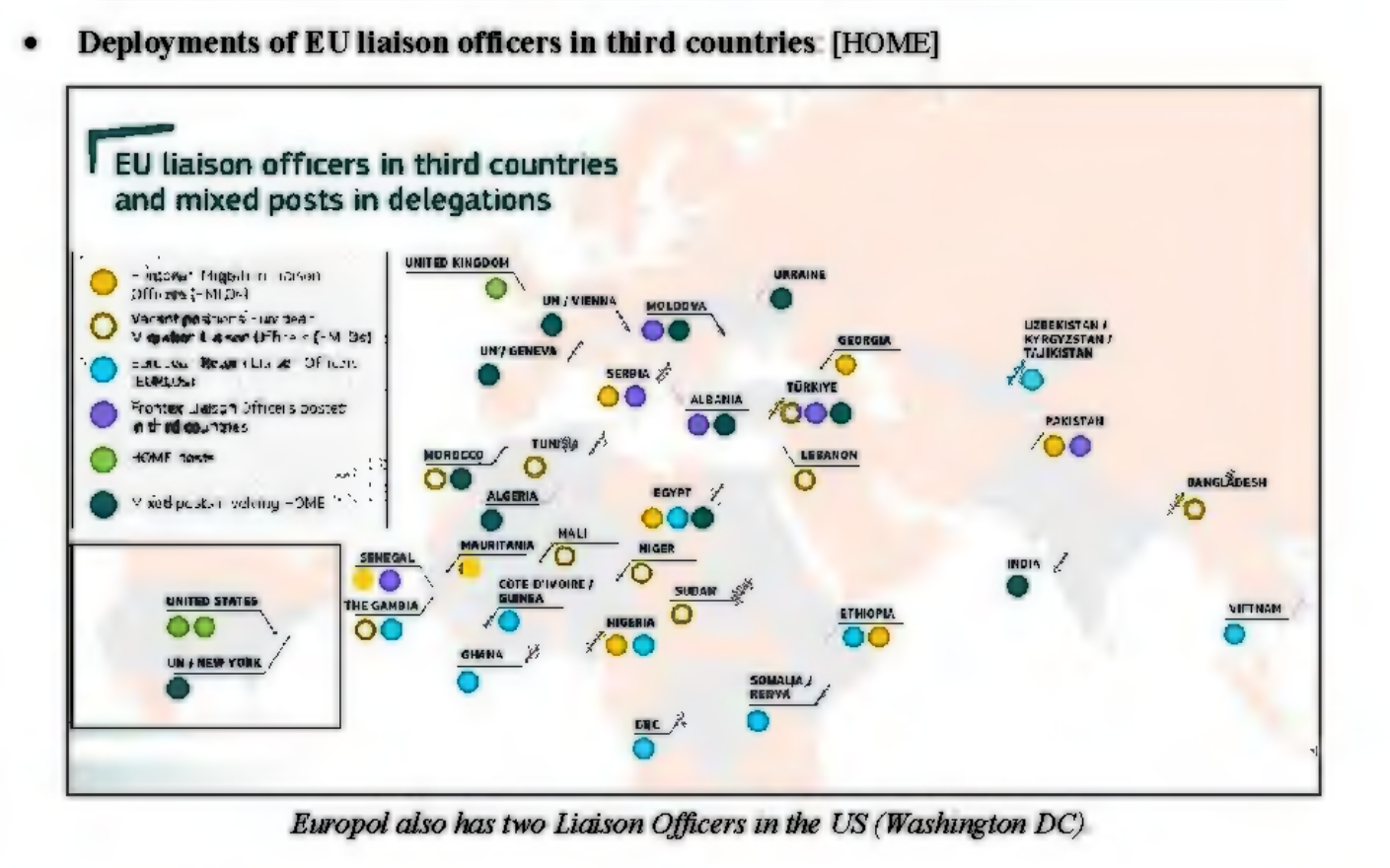
- A poorly-scanned diagram in the report indicates the presence of Frontex liaison staff across North and Sub-Saharan Africa, as well as Central, South and East Asia.
- The report notes that member state staffing levels for border control have in most cases been flat since 2023, with several “undertaking comprehensive assessments” of future staffing and resource needs. Training on weapons and fraudulent document detection for border staff is identified as a particular priority, as is the implementation of recommendations from the Schengen evaluation process.
- Member states are reported to be in the process of developing more sophisticated risk analyses for border checks, including “improving the use of profiles and indicators”, with the aim of “better integration of intelligence into frontline procedures”.
- Regarding contingency planning for border control (irregular migration in particular), Finland is held up as an exemplar. An increased integration of deportation measures into contingency planning is welcomed, though the report also complains that most member states have not yet fully integrated deportations into their national contingency plans.
- Some member states are reported to expect minimal EU support in contingency measures, pointing to poor coordination with Frontex and neighbouring countries.
Border surveillance
- “Notable progress” in strengthening border surveillance is reported, with Poland and Finland mentioned as having made “significant investments” and Cyprus, Italy, Malta, Croatia and Spain also commended.
- Stationary surveillance coverage of the external borders rose from 22% in 2021 to 35% in 2024. The use of drones has also increased.
- Nonetheless, the report urges continued efforts to increase surveillance capacities and operations to address “rising security threats and the ongoing presence of irregular migration” and bemoans that “many land border sections and vulnerable zones still lack continuous surveillance.” Sea border surveillance is identified as needing work, with “fragmented inter-agency coordination” and declining EUROSUR standards implementation blamed for “undermining effectiveness”.
- The EUROSUR “impact level” (a measure of the need for increased surveillance) for the English Channel and North Sea was raised from medium to high.
Deportations
- In the first half of 2025, just over 240,000 people received deportation orders in the Schengen area, the majority in France, Germany and Spain. Among those people issued orders, Algerian, Moroccan and Turkish national accounted for 20% between them. The report notes sharp increases in orders issued to Somali and Vietnamese nationals, 95% and 83%, respectively.
- Of these, just under 57,000 people were deported, a 9% increase on the same period in the previous year, with France, Germany and Cyprus reporting the most ‘success’ and member states generally reporting increasing deportations year on year. An accompanying diagram suggests Spain, Croatia and Romania were the least ‘effective’ deporters.
- Georgian, Turkish and Albanian nationals were the most deported, while Syrians were reported to have been deported at three times the previous rate (3,135 people in the first half of 2025). 90% of these deportations were by Cyprus, Austria and Croatia alone.Frontex is reported to have overseen 1,360 ‘voluntary returns’ of Syrians between March and June 2025. The EU Reintegration Programme, which was offered to Syrians from June 2025 (but is only offered to people staying irregularly and issued a deportation order) is reported to have been enjoyed by a total of just four people by the following month (though by September 2025, 1,000 people had been registered in the programme).
- Notably, while deportations from the EU were up overall, the requests for identification and travel documents fell considerably, possibly suggesting greater cooperation from third countries.
- The report, quoting a July 2025 internal assessment of ‘readmission cooperation’, notes “sustained and positive cooperation” on deportations by Bangladesh and Iraq.
- “Return alerts” under the Schengen Information System, including those with “security flags” attached, are reported to have increased substantially, though some member states are reported to be lagging in the process, with many not including fingerprint information in alerts, and seven states not including photographs or any identity documents.
Documentation
- Overall state of the Schengen area – Schengen Barometer+ (Council of the EU doc. no. 13141/1/25 REV 1, LIMITE, 29 September 2025, pdf)
Our work is only possible with your support.
Become a Friend of Statewatch from as little as £1/€1 per month.
Further reading
How the EU migration pact will increase harms in Serbia and along the Balkan route
The EU's Pact on Migration and Asylum is likely to send the situation for migrants and refugees in the Balkans from bad to worse: more containment of people on the move through cruel tactics such as policing and pushbacks; more bureaucracy and digital controls, without protection or safeguards; and a further closure of civic space. Real protection requires a different approach.
Documents: EU plans to radically expand border agency's mandate
Two recent European Council documents reveal internal discussions over the potential expansion of Europe's border agency Frontex. One aim is to make it easier for the agency to operate outside EU borders. The discussions come ahead of the expected formal revision of Frontex’s mandate in 2026 and give a glimpse of what member states and the European Commission have in mind for the agency’s role in the EU’s future deportation machine.

Exporting carceral migration “management”: €30 million from the EU to Senegal for migration control
€30 million from the EU's aid budget has been provided to Senegal for migration control. An examination of European Commission documents makes clear the main focus of the funding: border surveillance and control, maritime interception of people trying to leave Senegal to travel to European territory, and reception/detention infrastructure.

Spotted an error? If you've spotted a problem with this page, just click once to let us know.