Frontex uses border capacity review to argue its own value
Topic
Country/Region
29 April 2026
A report from the EU’s border agency Frontex examines the border control capacity of individual member states as well as the EU as a whole. Aside from offering considerable information updates, including changing migration flows and improved operational capacities in some regions, the report also serves as a way for Frontex to tout its own value and remind member states of its continued relevance, ahead of an expected mandate review later in the year.
Support our work: become a Friend of Statewatch from as little as £1/€1 per month.
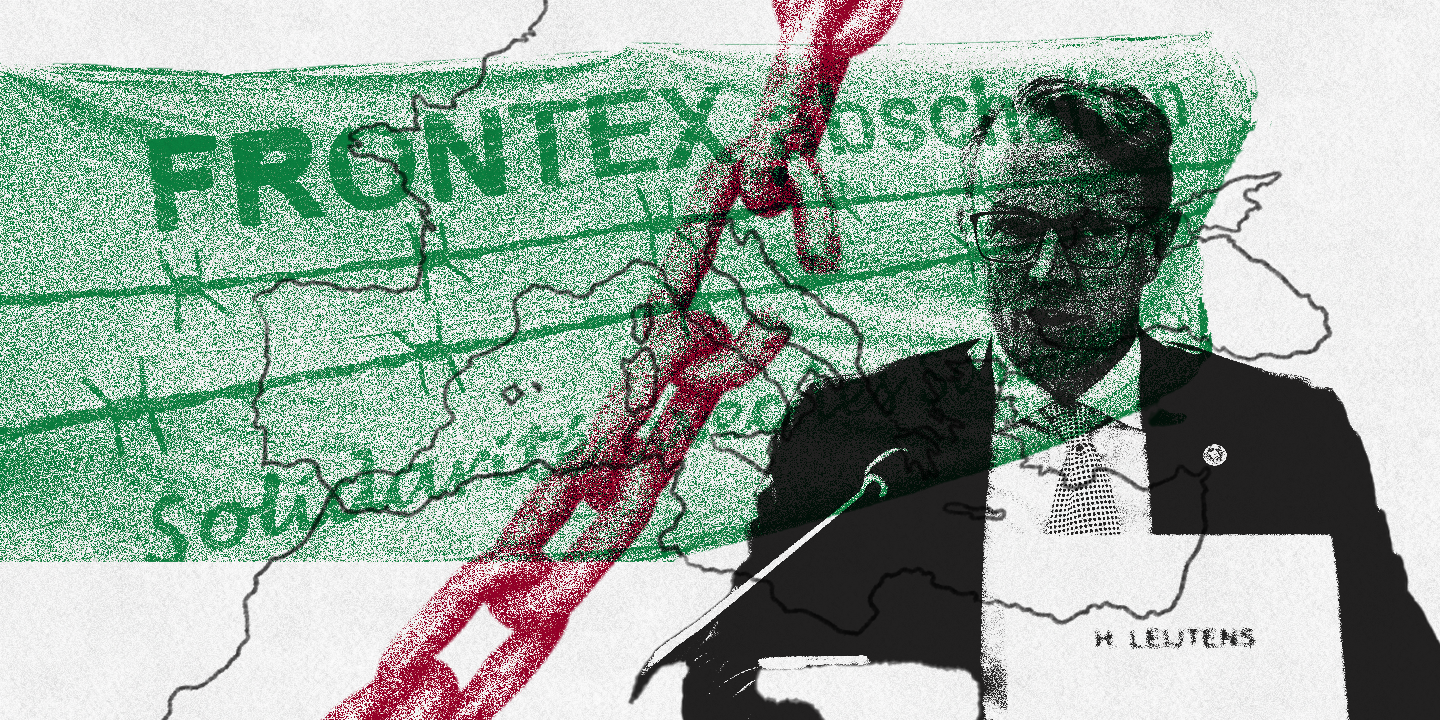 Image credits: “Demonstration, Hamburg, Germany, 2016-05-14” by Rasande Tyskar, CC BY-NC 2.0; “DROI meeting with Frontex director” by The Left, CC BY-NC-SA 2.0
The 2025 edition of what is known as the Frontex Vulnerability Assessment report, obtained by Statewatch, updates EU member states on the current status of border control across the bloc. The report, which was presented to the Working Party on Frontiers meeting of 5 February 2026, comes in three parts, an initial introductory section (pdf), an analysis of Europe’s various border regions (pdf) and a concluding section with annexes (pdf).
What are these assessments for?
These ‘Vulnerability Assessments’, which have been provided bi-annually over the past decade, are a way for Frontex to present the EU with its assessment of the most pressing border security needs and to suggest ways that its own operations and those of member states may be amended or updated in order to keep up. (If this seems a little like Frontex setting its own goalposts, you are not the first person to think that.)
The Vulnerability Assessment process itself is made up of ‘Baseline Assessments’ of member states’ borders, as well as ‘Simulation Exercises’ and so-called ‘Rapid Vulnerability Assessments’. It is part of a larger process of regular assessments which includes the annual Schengen Barometer+ report, which itself is informed by the Frontex assessment.
The document is useful for understanding the overall state of the EU’s border control regime. It also serves as an insight into the outlook of the Frontex executive, at a time when the future of the agency is not clear. The agency is due to have its mandate reviewed and potentially updated to expand its operational responsibilities later in 2026. The agency may be tasked with conducting deportations between non-EU countries and responding to so-called ‘hybrid threats’ such as the weaponisation of migration flows and the use of drones across EU borders. Frontex potentially being given these additional responsibilities is a controversial topic among policymakers and NGOs.
At the same time, the reputation of the agency has been damaged in recent years. There have been many serious incidents where, it is alleged, people were harmed or lost their lives at the hands of, or due to neglect by, European border guards and Frontex itself. Internal EU documents previously obtained by Statewatch have also shown some member states expressing discomfort with Frontex having an expanded role.
Reports such as this one, while not the explicit purpose, can serve as an opportunity for the agency to push its own value. It wants to project an image of competence and professionalism, while reminding member states of the myriad ‘threats’ to European security and stability on the horizon.
‘Hybrid threats’: Frontex making its case
In his introduction Frontex executive director Hans Leitjens states two of those key ‘threats’: the weaponisation or ‘instrumentalisation’ of migration flows and an increase in the use of drones for smuggling purposes. The key thing to note with these two issues is that the 'hybrid threats' concept blurs the lines between standard border control and military operations. This is something Leitjens notes in his introduction, stating that these developments highlight the “increasingly interwoven links between civilian border control and military considerations in the region.”
This blurring of the operational lines is particularly relevant as, if Frontex were to take on responsibility for these issues, it could represent the agency evolving into something more resembling a military force. The report body also nods to this:
“Instrumentalisation of migration by third countries blurs the distinction between the military and border-control domains.”
Within the report – particularly in reference to the EU’s Eastern borders where such ‘hybrid threats’ are felt most present – Frontex appears anxious to at once emphasise the military nature of such threats while also warning member states against handing over responsibility to national militaries. For instance, the report notes that Estonia’s navy has taken up responsibility for maritime migration surveillance, something the authors seem to feel would be better handled by Frontex, given their specialist training in border control.
Aside from these particular concerns over its mandate review, Frontex also appears concerned in general with embedding itself into the border control regime of each individual member state, at times explicitly reminding them of the value of its assessment process:
“The value of this dedicated quality control mechanism for border control is indisputable”
It also reiterates its desire for greater intelligence sharing between Frontex and member states as well as between the member states themselves. The general impression one gets from the language of this report is that Frontex really wants member states to think of the agency as a net positive:
“With trustful cooperation, Member States and Frontex perpetuate positive change”
Below is a summary of the substantive information in the report.
The overall outlook:
The report’s intro makes note of certain ‘persistent vulnerabilities’ but also ‘positive developments’. The main positive development’ in the eyes of Frontex is that there are fewer ‘vulnerabilities’ at the EU’s borders. These are best understood as ‘weak points’ that leave the potential for people to enter the EU without prior authorisation, something that Frontex is existentially against. The report notes just over 100 such vulnerabilities, less than half the amount identified when the assessment process began.
Generally, improvements are reported on border check procedures, the greater use of common migration and security databases, improved staffing, training and infrastructure and greater capacity for fraudulent document checks. Improvement is also reported in ‘contingency planning’, which is to say member states having plans in place to handle an unexpected increase in irregular migration.
The report notes a general rise in national spending on border control in recent years. It bemoans, however, that some of this increase is made up of ‘one-off’ infrastructure investments rather than consistent funding increases, and that funding for operations around the Mediterranean is not growing as much as desired.
One particular concern for Frontex is that member states have, as a general rule, contributed less of the labour of their own national border staff to long-term Frontex deployments around Europe. It does note, however, a slight improvement in contributions for short-term deployments and a “major” improvement in equipment contribution. Continued “obstacles” remain for member states physically hosting Frontex staff, perhaps reflective of the general unease some member states appear to have about the agency’s standing corps increasing.
Eastern Borders
Unsurprisingly, the section of the report dedicated to the EU’s Eastern Borders focusses on threats related to Russia and Belarus, namely those ‘hybrid threats’ wherein enemy states allegedly use novel methods (such as shepherding migrants to a certain border or cutting undersea cables) to try to harm the stability and security of the EU.
In light of these threats, the report notes a “significant enhancement” of surveillance infrastructure on the Eastern borders, including stationary surveillance infrastructure and investments in mobile surveillance equipment such as drones and patrol cars. It describes, however, a lack of border staffing as “the most exigent challenge”.
According to the report, the use of drones by smugglers has risen “exponentially”, though it does not explain exactly how drones are used. It does, however, play into the potential Frontex mandate expansion, as the use of drones in a ‘hybrid threat’ context is another operational responsibility potentially on the table.
This section makes the militarised framing of the ‘hybrid threats’ issue clearer. It acknowledges that, in the ‘instrumentalisation’ context, the concept of irregular migration, “traditionally addressed in the framework of border control” is now treated as a military issue.
Nudging to the future, the report pushes the idea of the “potential for an expansion of guard competences aimed at responding to these novel threats.”
South-Eastern Borders
This border region – part of the ‘Western Balkans migratory route’ - remains one of the “main entry points” for irregular migrants, with a “considerable rise” noted on the Bulgarian section of the border with Turkey. (Confusingly, the report also says there has been a drop in attempted crossings, possibly suggesting that while fewer people overall are trying to cross into the EU, those that are trying are more successful.) It is reported that in 2024 Bulgaria saw a “major increase” in patrol cars along its borders with Turkey and Serbia.
Elsewhere on the route, capacity to detect border crossings in Albania, North Macedonia and Serbia is described as “deteriorating”. This is attributed to insufficient surveillance and patrolling. Croatia, meanwhile, is reported to have emerged as the “main entry point” for the Western Balkan route. This is due, in part, to more stringent operations by Serbian authorities on the border with Hungary, leading to a “redirection” of migration flows. Croatia is reported to have implemented previously recommended Frontex measures in order to address this, in particular an increase in “accommodation capacity” in order to prevent secondary movements.
A camera system is reported to be under construction along the Hungary-Serbia border, and Frontex conducted simulation exercises to detect weapons smuggling on Hungary’s borders with Serbia and Ukraine.
Another simulation exercise, this time focussed on Bulgaria’s border with Turkey, interrogated border guards’ capacities to “detect travelling terrorists and other subjects of interest”. While Frontex assessors found that border guards were for the most part able to detect such people, this appears to be a result of an overly-suspicious approach, with simulated ‘bona fide travellers’ apparently “overwhelmingly classified as suspicious”.
Southern borders:
This region is defined as the “dominant challenge” regarding irregular migration in Europe, with the highest number of vulnerabilities. In particular, the report urges continued upgrades to maritime surveillance infrastructure.
There has been an (already well documented) drop in crossings via the Central Mediterranean route (ie from North Africa to Italy), as well as the Western Mediterranean route (typically North Africa to Spain), the latter due in part to more restrictive measures taken by Moroccan authorities. Migration flows being fluid, however, the report notes crossings from Algeria to the Balearic Islands, as well as a “spike” in crossings from eastern Libya to Crete (Crete in particular was identified in the assessment as lacking proper border control infrastructure). The Western African route (from West/North Africa to Spain’s Canary Islands), is reported to have recorded the highest number of arrivals since 2006.
Frontex urges member states make better use of the Eurosur information databases, and complains that some ‘National Coordination Centres’ around the southern borders remain “insufficient”. The report also urges greater surveillance build-up along the EU’s southern maritime borders, reporting that Greece, Spain and Malta are working on it. Portugal and Italy are encouraged to implement more of their own measures.
Overall, with “large numbers of migrants” reaching Europe via maritime routes, the report stresses more action be taken to increase patrolling, surveillance and information exchange. Increasing capacity for the reception and registration of people arriving is also highlighted as an urgent need across the EU’s southern border states.
Our work is only possible with your support.
Become a Friend of Statewatch from as little as £1/€1 per month.
Further reading

Spotted an error? If you've spotted a problem with this page, just click once to let us know.