From fragments to a systematic picture: glimpses into an immigration detention centre in Bosnia and Herzegovina
18 May 2026
The charity Collective Aid has published a report on Lukavica, Bosnia and Herzegovina’s only official immigration detention centre. Lukavica is hidden from public view even as there are extensive concerns about the conditions for detainees, legal opacity and a lack of accountability. This article, written for Statewatch by Anna Gruber, Advocacy Manager at Collective Aid, explains the documentation process behind the report and what Collective Aid has managed to learn about detention in Lukavica.
Support our work: become a Friend of Statewatch from as little as £1/€1 per month.
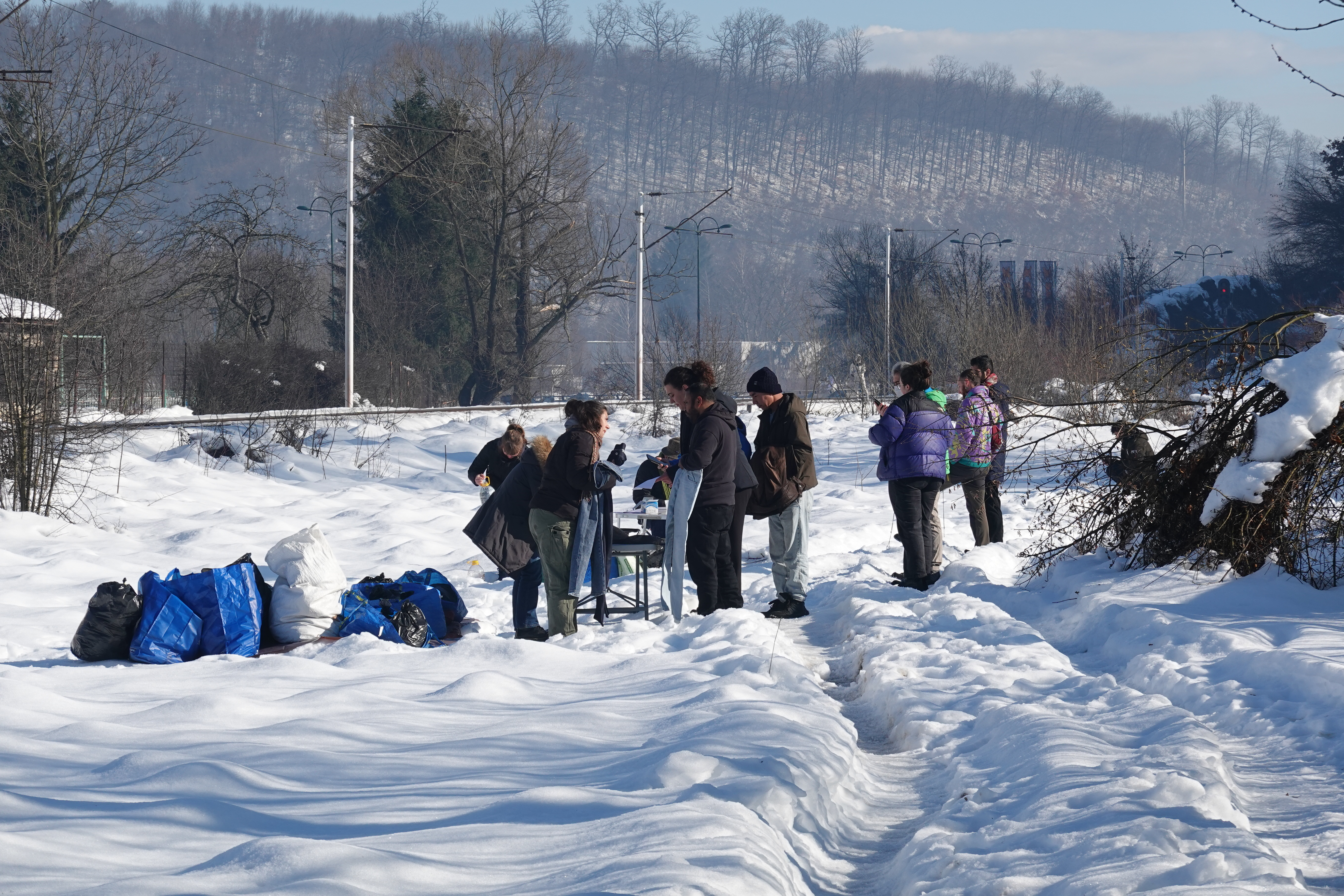
(Image: a Collective Aid distribution. Credit: Collective Aid)
Setting the scene
In Sarajevo, Bosnia and Herzegovina, our team distributes non-food items outside the Blazuj Temporary Reception Centre five days a week. We usually arrive with two cars, set up a distribution point and place a table with tea and juice where we speak with people about their experiences.
Someone comes for shoes, a winter jacket or a quiet moment, and then mentions in passing that a friend has been taken to Lukavica. Or they tell us someone they met yesterday was released from detention without papers, or that a relative has disappeared into the detention system with no way of getting in touch. Sometimes a clue comes more indirectly: a passing mention in a news article, or a story heard from a partner organisation. These are not always full testimonies. More often they are snippets, loose ends, details that only begin to matter when they recur.
Lukavica sits on the outskirts of East Sarajevo, physically removed from everyday public life. The centre has operated for years in a grey zone of legal ambiguity, where people are held on broad grounds, legal remedies are weak and independent oversight is limited or denied. Often those little fragments of information are all we have to rely on.
These fragments are easy to miss if you are looking for a simple story about immigration detention. But Collective Aid’s work depends on recognising that violence can only be understood by putting the pieces together. Our report on Lukavica is built on exactly that kind of evidence: conversations on the ground, FOI responses, stakeholder interviews, official data, desk research, media references, partner accounts and the repeated details that begin to form a pattern.
The first clue
One of the hardest things about documenting detention is that the system is built to make things less clear. A person may know they were picked up during a raid, transferred from a reception centre, or moved after a border stop, but they might not know exactly which authority made the decision, what the legal basis was or how long they may be held. Often, they leave detention with only a partial understanding of what happened, while family members and friends are left trying to figure out what happened.
That is why the scraps of information gathered in everyday contact matter so much. Our field work includes distributions, encounters with people on the move and conversations with those just released from detention, or people looking for someone who was detained. In those settings, people often share only the smallest part of the story: a name, a place, a cell, a route. Lukavica came up many times in the course of this work, but it was named explicitly only twice in direct testimony to us: once in 2024 and once in 2026. The rest of the picture emerged elsewhere, through conversations with lawyers, FOI requests, desk research, media reporting and open-source material. All these fragments needed to be carefully compared and verified.
Our report turns these fragments into something more solid. It shows that Lukavica is not an isolated holding site but part of a wider detention and deportation ecosystem, shaped by Bosnia’s legal framework, international pressure and the growing role of externalised migration control in European policy.
What Lukavica does
Lukavica is not simply a place of waiting. It is a place where people are sorted, contained and kept in limbo under a legal framework that lets authorities mostly do what they want. Between 2018 and 2024, 4,631 people were detained there, according to our research. This includes 115 children and 263 women.
What we know about Lukavica reveals a familiar and alarming pattern: poor conditions, restricted contact with the outside world, barriers to legal aid and a system where the right to appeal is weakened by the fact that an appeal does not suspend deportation. People can be detained, transferred or expelled before their challenge is even heard.
For the people Collective Aid speaks with, this experience is a long, disorienting stretch of uncertainty. Some people come out of Lukavica with only a partial understanding of why they were held. Others are looking for friends who never reappeared. In these moments, detention is not just a legal problem. It is a missing person problem, a family problem and a problem of fractured memory.
All this takes place in a wider institutional context. Lukavica is not just a detention centre run by a single authority. It is part of a system involving the Service for Foreigners Affairs, the Ministry of Security, the Ombudsman, the International Organisation for Migration (IOM) and wider EU-backed migration control structures. Responsibility is spread across institutions, making it harder to hold people accountable. When a story reaches us, it has passed through many hands and each layer adds another fragment.
Conditions inside Lukavica
Once those fragments are placed side by side, a clearer picture emerges of life inside Lukavica: overcrowded cells, broken sanitation facilities, rationed water, poor quality food, severe restrictions on movement and contact and an atmosphere of coercion and neglect. Accounts from detainees – collected by us and Human Rights Watch - describe an older section of the centre with broken toilets, damaged furniture and poor ventilation, where walls are covered in black and green mould. People are generally kept in shared cells, three to five to a room, behind locked doors and under constant camera surveillance, with movement outside the cells dependent on escort by guards.
Detainees report very limited access to water, with some saying they had to drink water from the sink beside the toilet and received only one or two cups of water a day. Meals are described as basic and nutritionally poor, often consisting of bread with a small amount of spread, soup, yogurt, or sausage. Apparently the food is even worse on weekends. Basic hygiene items are limited. Access to soap or other supplies often depends on money deposited into the centre’s account by relatives. Some people say the guards took the money they had on them, in order to “cover” the cost of detention.
Detainees described guards as insulting, humiliating and in some cases physically violent, contributing to a climate in which people felt they were being treated like criminals. In a setting where movement is tightly controlled and outside oversight is limited, it is almost impossible to complain or seek redress.
Health care is presented by the authorities as available on site, with medical checks on arrival and referrals to outside facilities when needed, but detainee accounts suggest this is largely an illusion. People reported that staff did not proactively check whether someone was unwell, that medical attention depended on detainees being able to ask for help, and that even obvious needs would go unanswered for long periods. In some cases, people said they received only minimal treatment for pain or illness.
Although detainees should get at least two hours of outdoor time a day, they and their legal aid providers described months without access to outdoor space, and some people were not allowed out of their cells at all. Phone access is similarly constrained: calls are only possible via scheduling, outgoing calls are not easily made, and people often cannot reach lawyers or family except through indirect networks.
Collective Aid’s documentation method
In order to make sense of the fragmented evidence we hear about detention and human rights in Bosnia, our team developed a new methodology.
Total Incident Ecology, or TIE, is a way of turning scattered, low-visibility information into a structured picture. Instead of treating each testimony, FOI response, media reference, or field note as a separate and self-contained fact, TIE asks what these fragments reveal when they are read together over time, across sources and in the wider context.
Individual incidents are often contestable, but recurring patterns are harder to deny. In contexts of legal opacity, restricted access and institutional silence, one account may be dismissed as incomplete or anecdotal. Multiple accounts, however, can begin to show a repeated practice, an operational routine or a governing logic. TIE therefore treats incident-level data as the building blocks of a broader ecology of harm, rather than as isolated events.
TIE distinguishes between collecting information and claiming certainty. A fragment of information can be useful even if it is not yet fully corroborated, as long as its source, context and limitations are recorded carefully. That makes the method especially useful for detention documentation, where direct access is restricted and people affected by the system may only be able to share fragments of what happened to them.
The value of TIE is that it makes it possible to move from fragmentary evidence to defensible findings about a system. In the case of Lukavica, that means linking repeated mentions, official data, legal barriers and institutional practices into a picture of detention that is systematic.
The hidden machinery
Lukavica cannot be understood on its own. The wider context matters because it explains why detention persists even when criticisms have been made for years. There have been so many concerns expressed about access to legal aid, health care, interpretation and the detention of minors. Yet the centre continues to operate with little visible consequence for the institutions responsible. The problem is not a lack of knowledge. The problem is what happens when knowledge does not translate into accountability.
Collective Aid's full report, Inside Lukavica: Bosnia's Immigration Detention Black Box, is available to read online.
Our work is only possible with your support.
Become a Friend of Statewatch from as little as £1/€1 per month.

Spotted an error? If you've spotted a problem with this page, just click once to let us know.