UK: Inquiry needed over lack of enforcement against "egregious and repeated data breaches"
Topic
Country/Region
21 November 2025
More than 70 civil society organisations, academics and data protection experts, including Statewatch, have called for an inquiry into the collapse in enforcement activity by the Information Commissioner’s Office (ICO). The call comes after the ICO failed to launch an investigation after the Ministry of Defence published a spreadsheet containing the details of over 19,000 people fleeing the Taliban in Afghanistan.
Support our work: become a Friend of Statewatch from as little as £1/€1 per month.

Image: Stephanie Asher, CC BY-NC-SA 2.0
Dame Chi Onwurah DBE MP
Science, Innovation and Technology Committee House of Commons
London SW1 0AA
21 November 2025
INFORMATION COMMISSIONER’S PERFORMANCE: A CALL FOR AN INQUIRY
Dear Dame Chi Onwurah DBE MP,
We are writing to you as a group of civil society, academic and legal practitioners. We are concerned about the collapse in enforcement activity by the Information Commissioner’s Office, which culminated in the decision to not formally investigate the Ministry of Defence (MoD) following the Afghan data breach.
Data protection cuts across sectors and society. It is an important line of defence against abuse and discrimination in healthcare, in the workplace, in public service delivery, in immigration control, in policing, in education. Data breaches expose individuals to serious danger and are liable of disrupting government and business continuity.
However, in a recent public hearing hosted by your committee, Commissioner John Edwards has shown unwillingness to reconsider his approach to data protection enforcement, even in face of the most serious data breach that has ever occurred in the UK. This approach threatens UK residents’ data rights and well-being, leaves organisations on a weak footing to face growing data security threats, and imperils the government’s central growth mission.
Evidence shows a strong correlation between the ICO lack of formal regulatory action and a surge in, sometimes egregious, data breaches in the UK.
As the ICO's own post-implementation review of its new Public Sector Approach (PSA) disclosed, “the average number of reported breaches increased by 11%”[1] following its adoption. The PSA is an ICO internal policy which prioritises engagement and public ‘name and shame’ instead of dissuasive and legally binding enforcement action. Likewise, the review notes that complaints from the British public against public sector organisations have since increased by 8%, with peaks of 21% and 12% in the justice and public health sectors respectively.[2]
Indeed, egregious and repeated data breaches have affected victims of the Windrush scandal,[3] 9,400 Northern Ireland police officers,[4] the electoral records of 40 million UK residents,[5] and 19,000 Afghanis being relocated by the MoD.[6] Despite the severity of these incidents, the ICO has applied its public sector approach and either issued reprimands — written notices that lack the force of law — or significantly lowered the monetary penalties it awarded. Further, the ICO decision not to pursue any formal action against the MoD despite their repeated failures was extraordinary, as was its failure to record its decision making. The picture that emerges is one where the ICO public sector approach lacks deterrence, and fails to drive the adoption of good data management across government and public bodies.
The handling of the Afghan data breach is not an isolated case; many are being let down by the ICO and its numerous failures to use corrective powers.
Alongside the shift away from enforcement in the public sector, statistics show that private sector enforcement is also becoming a rare occurrence from the ICO. Indeed, the latest ICO Annual Report reveals a sharp drop in formal investigations, criminal prosecution, and in the issuing of enforcement notices, monetary penalties, and reprimands.[7] Dovetailing the ICO’s move away from formal regulatory action, there has been a clear increase in the number of complaints from 2023 onwards.[8] This suggest that organisations are diverting resources away from compliance and responsible data practices, knowing that the ICO is not going to pursue the matter.
The ICO's response to changes to UK data protection law further exacerbate these risks. With a recent call for views on regulating online advertising, the ICO has proposed to interpret their duty to promote growth and innovation as grounds to tolerate non-compliance with legal requirements that protect Internet users from predatory advertising, micro-targeting and political profiling.[9] In another consultation, the ICO is proposing to radically curtail its handling of complaints so that many will not be investigated, but merely recorded for information purposes.[10] This posture contradicts what the law stipulates, nor does it reflect repeated reassurances from Parliament and the government that the Data (Use and Access) Act would have not lowered data protection standards in the UK.
Change appears to be unlikely unless the Science, Innovation and Technology Committee uses their oversight powers and steps in.
Parliament has given the ICO considerable powers not to politely hope for the best, but to enforce compliance with legally binding orders. As we heard from the public hearing you hosted, the ICO chose not to use these powers to address the Afghan data breach, a decision strenuously defended by the Information Commissioner.
Unfortunately, the Afghan data breach is not an isolated incident, but the symptom of deeper structural failures which are emerging in the way the ICO operates. The recent call for views on enforcement procedural guidance “aims to increase transparency”[11] about how the ICO investigates infringements, but does not change or even leave room to question the ICO overall approach to enforcement.
Thus, we believe it would be of immense benefit to UK citizens, and to the shape of the UK’s digital economy, for your Committee to open an inquiry to investigate the Information Commissioner’s Office, and understand why data protection enforcement appears to be a low priority.
Signed:
5Rights Foundation
Alison Benson, Information Governance Professional
Amory Creese, Senior Lecturer
Andrew Kent, LL.M candidate
Ann Kristin Glenster, Professor at Minderoo Centre for Technology and Democracy, University of Cambridge
Aysem Diker Vanberg , Senior Lecturer in Law
Big Brother Watch
Birgit Schippers, Senior Lecturer in Law at University of Strathclyde
Dr C N M Pounder, Director at Amberhawk Training Limited
Connected by Data
Cristina, Director at CVG Solutions Ltd
Damian Clifford, Assistant Professor at LSE
Dr Daniella Lock, Lecturer in Law
Data, Tech & Black Communities CIC
Professor David Erdos, Professor of Law and the Open Society, University of Cambridge
Douwe Korff, Emeritus professor of International law
Duncan Campbell, Senior Visiting Research Fellow, at School of Law, University of Sussex
Edina Harbinja, Associate Professor in Law at University of Birmingham
Ekō
Eleonor Duhs, Barrister
Emma Campbell, Program Manager at Data Privacy & Compliance at Media Company
Emma Crisp, Data Protection Manager
European Digital Rights (EDRi)
Fair Vote UK
Dr Fiona Brimblecombe, Legal Academic
Forward Democracy
Foxglove
Dr Gina Helfrich
Global Link
Good Law Project
Professor Guido Noto La Diega, Professor of Law, Technology and Innovation at University of Strathclyde
Henry Pearce, Senior Lecturer in Internet Law at Queen Mary University of London
Hermes Center
Hugh Tomlinson KC, Barrister
Irish Council for Civil Liberties
Jane Kaye, Professor
Jennifer Cobbe, Assistant Professor in Law and Technology at Faculty of Law, University of Cambridge
Kathryn Corrick, Founding Partner
Kay Young, Information and Records Management Lead
Kiran Kiani, Assistant manager legal
Li Min Ong, PhD Candidate in Law
Lilian Edwards, Emerita Professor of Law, Information and Society at Newcastle Law School
Matthew Jewell, Director at Assure Start Ltd
Mengyi Mei, PhD Candidate in Law
Michael Hrebeniak, Founder at New School of the Anthropocene
Mitchell Omer, Director at Trust Keith
Naomi Colvin, Independent Researcher
Nathan Fowler, Director at Freevacy ltd
Nicholas Gervassis, Assistant Professor in Law (Technology & Data) at University of Nottingham
Dr Oliver Butler, Assistant Professor in Law at University of Nottingham Open Rights Group
Orla Lynskey. Professor
Paul Bernal, Professor of Information Technology Law at UEA Law School
Professor Paul Wragg, Professor of Media Law at University of Leeds
Dr Peter Coe, Associate Professor in Law at University of Birmingham
People vs Big Tech
Ralph O'Brien, Principal at REINBO Consulting and Institute of Privacy by design
Ray Corrigan, Senior Lecturer in STEM at The Open University
Rebecca Mosavian, Associate Professor at School of Law, University of Leeds
Rowenna Fielding, Director at Miss IG Geek Ltd
Simon Nixon, Senior Compliance Manager
Statewatch
Suze Phillips, Director of Data Protection Services at Garden City Assurance Ltd
Tara Taubman
Tetyana Krupiy, lecturer at Newcastle University
The Electronic Privacy Information Center (EPIC)
Tim Bell, Managing Director at DataRep UK
Tom Stoneham, Professor of AI & Data Ethics at University of York
Dr. Tony Roberts, Fellow at Institute of Development Studies
Tony Sheppard, Founder at My Data Protection World
Tristan Henderson, Senior Lecturer in Computer Science at University of St Andrews
Wendy M. Grossman Author at net.wars
Worker Info Exchange
[1] See ICO, Post-implementation review annexes: Public sector approach trial, p.15, at: https://cy.ico.org.uk/media2/migrated/4032078/psa-post-implementation-review-annexes.pdf
[2] Ibid, p.17
[3] See ICO, Action we have taken, at:
https://ico.org.uk/action-weve-taken/enforcement/2022/08/secretary-of-state-for-the-home-department-home-office/
[4] Ibid, at: https://ico.org.uk/action-weve-taken/enforcement/police-service-of-northern-ireland-mpn/
[5] Ibid, at: https://ico.org.uk/about-the-ico/media-centre/news-and-blogs/2024/07/ico-reprimands-the- electoral-commission-after-cyber-attack-compromises-servers/
[6] Ibid, at: https://ico.org.uk/action-weve-taken/enforcement/2024/02/ministry-of-defence-1/
[7] See Information Commissioner’s Annual Report and Financial Statements 2024/25, at: https://ico.org.uk/media2/1wyfliqp/annual-report-2025-ico-v4-1-complete.pdf
For a quick overview: The UK Information Commissioner’s Annual Report 2024/25: Surveying a Systematic Trend Away from Adequate Enforcement, at: https://inforrm.org/2025/07/22/the-uk-information-commissioners- annual-report-2024-25-surveying-a-systematic-trend-away-from-adequate-enforcement-david-erdos/
[8] See Cause for Complaint: Assessing the ICO’s Proposed New Approach to Data Protection Complaints, at: https://inforrm.org/2025/10/28/cause-for-complaint-assessing-the-icos-proposed-new-approach-to-data- protection-complaints-david-erdos/
[9] See ICO call for views on our approach to regulating online advertising, at: https://ico.org.uk/about-the-ico/ico- and-stakeholder-consultations/2025/07/ico-call-for-views-on-our-approach-to-regulating-online-advertising/ See also: Cookie Consent Review Exposes Weaknesses in UK Data Protection Reform, at: https://www.openrightsgroup.org/blog/cookie-consent-review-exposes-weaknesses-in-uk-data-protection-reform/
[10] See ICO consultation on draft changes to how we handle data protection complaints, at: https://ico.org.uk/about-the-ico/ico-and-stakeholder-consultations/2025/08/ico-consultation-on-draft- changes-to-how-we-handle-data-protection-complaints/
[11] See ICO consultation on data protection enforcement procedural guidance, at: https://ico.org.uk/about-the- ico/ico-and-stakeholder-consultations/2025/10/ico-consultation-on-data-protection-enforcement- procedural-guidance/
Our work is only possible with your support.
Become a Friend of Statewatch from as little as £1/€1 per month.
Further reading
UK undermining data protection rights and putting EU agreements at risk
Changes to UK law will undermine data protection standards, posing risks to individual rights and leading to calls for the EU to review the "adequacy decisions" that deem the UK a safe destination for transfers of personal data. A letter from seven organisations, including Statewatch, calls for the EU to urgently reassess the UK's adequacy status, "to protect fundamental rights and uphold its credibility as both the guardian of the EU’s legal order and a global leader in digital rule-making." However, the EU is also currently seeking to downgrade data protection standards, for the same purpose: economic deregulation.
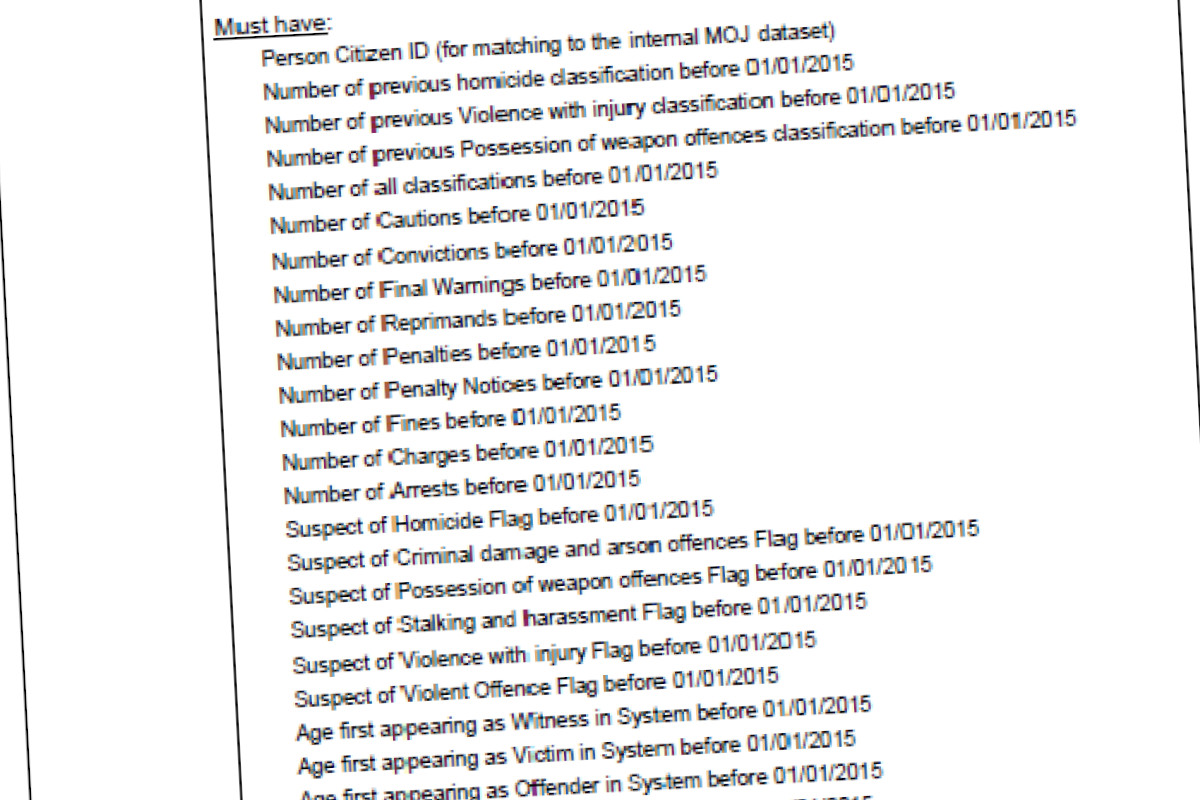
UK: Ministry of Justice secretly developing ‘murder prediction’ system
The Ministry of Justice is developing a system that aims to ‘predict’ who will commit murder, as part of a “data science” project using sensitive personal data on hundreds of thousands of people.
UK government wants to legalise automated police decision-making
A proposed law in the UK would allow police decisions to be made solely by computers, with no human input. The Data Use and Access Bill would remove a safeguard in data protection law that prohibits solely automated decision-making by law enforcement agencies. Over 30 civil liberties, human rights, and racial justice organisations and experts, including Statewatch, have written to the government to demand changes.

Spotted an error? If you've spotted a problem with this page, just click once to let us know.