Reclaiming migration: a call for justice, dignity, and an anti-racist Europe
Topic
Country/Region
18 December 2025
To mark International Migrants Day more than 40 organisations, including Statewatch, are calling for "a Europe grounded in justice and equality" and "policies that honour dignity and rights of all."
Support our work: become a Friend of Statewatch from as little as £1/€1 per month.
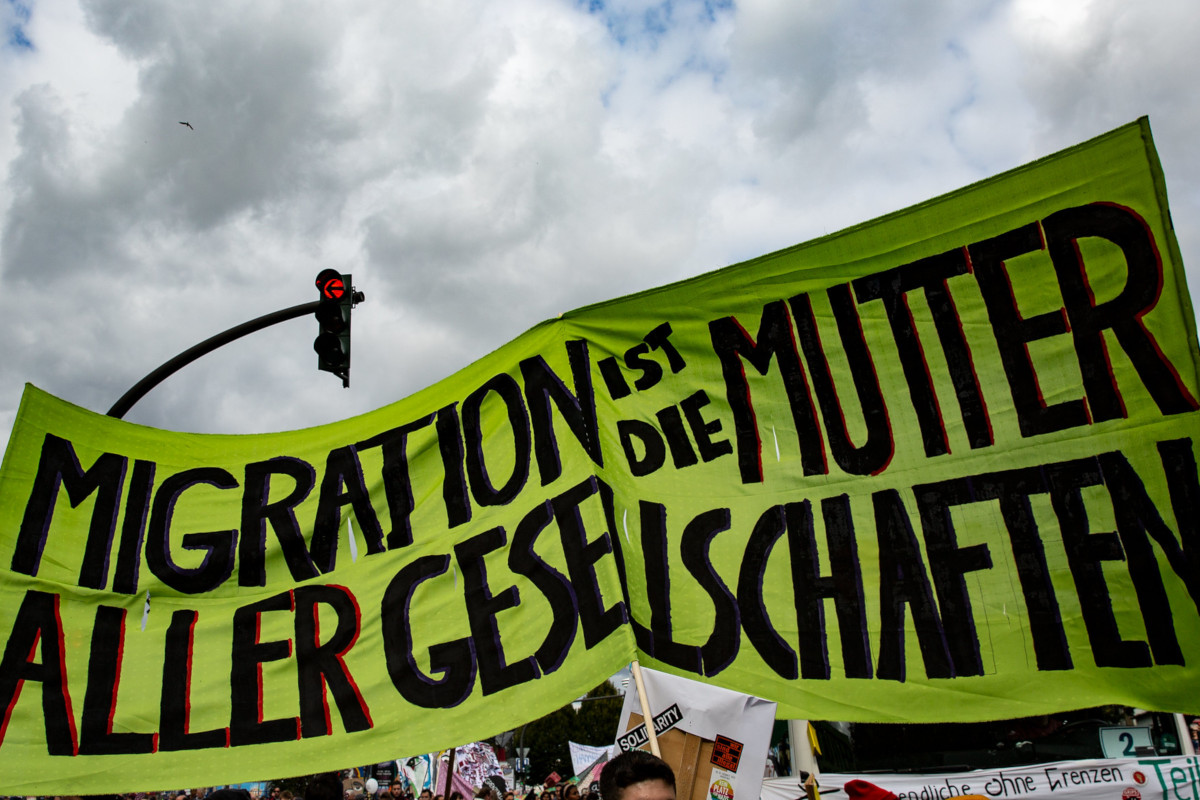
Image: Rasande Tyskar, CC BY-NC 2.0
This statement was coordinated by the European Network Against Racism. It is also available as a PDF.
Today, on International Migrants Day, we honour the countless people who move across borders, cities, and continents – in search of safety, opportunity, family, and freedom. Migration is not an exception, problem, or emergency, nor should it be categorised as such. It is a fundamental and enduring part of what it means to be human. Historically, people have moved and continue to move for countless reasons – to study, to work, to care for loved ones, to escape violence or inequality, or simply to build a better life. Yet across Europe, this basic human reality continues to be distorted to justify racist and inhumane policies, as part of repressive systems of control.
We condemn any policy choice by European countries and institutions that has led to death, misery, and suffering inflicted on migrants in and around Europe. But today we also celebrate people who cross borders for various reasons – especially those who are racialised and marginalised, whose lives, work, and contributions sustain our societies, even as they are systematically excluded, criminalised, and dehumanised by the very institutions and communities that depend on their knowledge, care, and human capital.
Today, we acknowledge those who move through their journeys, with hope, resilience, and a sense of connection beyond borders. In these journeys, we see not a crisis, but a possibility; not a threat, but the beating heart of shared humanity, rooted in life, dignity, and belonging. Their presence is a testament to perseverance; it is also a call for justice – a reminder to Europe to finally honor and defend their rights as a fundamental step toward building a more just and equitable society for all.
Migration governance as the new face of racism in Europe
In recent years, a dangerous political logic has deepened across Europe. Across a growing body of legislation – from the Pact on Migration and Asylum to the Schengen Borders Code reform, and now the proposed Deportation Regulation and the Facilitation Directive – migration, (particularly of racialised peoples from the Global South) is increasingly framed as a security threat to be controlled rather than a natural and enduring aspect of human life. This securitised approach has accelerated alongside the rise of authoritarian forces within Europe, reinforcing policies that criminalise movement and undermine fundamental rights.
Across Europe, the same patterns are evident – large-scale interceptions, violent pushbacks, mass detention, and deportations across multiple European countries; the criminalisation of undocumented and irregularised people; intensified border controls and racial profiling at internal borders.
Migrant workers – many of them racialised – labour in agricultural fields under conditions that resemble modern-day servitude sustaining entire food systems while living with exploitation, unsafe housing, lack of access to healthcare and chronic precarity; house and workplace raids targeting migrants; and continuous vilification in media and public discourses.
All of this is reinforced by legal and policy infrastructures that do not simply ‘govern’ migration but actively produce irregularity: restrictive visa regimes, employment rules that tie people to exploitative employers, endless bureaucratic delays, and pathways to residence so narrow that falling out of status becomes almost inevitable. In this system, irregularity and precarity are not accidents – they are the predictable outcome of policies designed to keep certain people vulnerable, deportable, and easily exploited. It is within this machinery that colonial and racialised hierarchies of mobility persist, determining who can move freely and who cannot; who has access to welfare and assistance; who is able to secure employment, housing, and education; and who is permitted to build a life within European societies.
These dynamics are not confined to asylum seekers or refugees. They shape the experiences of students, workers – including care workers – seasonal labourers, and families alike. In doing so, racialisation turns migration into a privilege for some and a source of precarity and dispossession for others.
But none of this is new. The racialisation and criminalisation of the movement of particular groups is rooted in centuries of colonial practice and labour exploitation. However, migrants and allies are not staying silent: across Europe, solidarity movements are growing, as communities continue to organise, resist, and build networks of care despite repression.
The cost of Fortress Europe
Instead of investing into social systems, European governments channel billions of euros of public money into wars, border militarisation, surveillance technologies, detention camps, deportation machinery, and private contractors that profit from people’s exclusion – while pointing the finger at migrants for the social and economic collapse their policies cause.
Reports show that securitisation policies do not provide safety; on the contrary, they promote death, fear, vulnerability, and instability. They force people to move regardless of their motives – into irregularity, exploitation, and danger. They divide communities, reinforce racialised hierarchies, further delegitimise the promise of the rule of law, and erode the right to live with dignity for everyone.
Reclaiming migration: our vision for a just and caring Europe
Migration is not a problem to be solved by increased securitisation and criminalisation, but a human reality that demands robust systems of social care, meaningful institutional support, and a sustained political commitment to dismantling deep-rooted structural racism across the legal, social, and economic structures that shape people’s lives.
As migrants and as Europeans, we call for a Europe that recognises human mobility as a social, cultural, and economic asset, and that dismantles the systems which criminalise and racialise movement. We demand policies rooted in anti- racism, care, equality, equity, and justice – policies that honour the dignity and rights of all.
Therefore, we envision a Europe that:
- Ends the criminalisation of all migrants – regardless of status, pathway, or reason for migration, dismantles the systems that produce irregularity, precarity, and deportability, and delivers accountability for human rights violations and abuses.
- Redirects public resources away from border militarisation and punitive migration governance, and toward strengthening social infrastructures such as affordable housing, universal healthcare, education, and community- based support
- Guarantees secure residence, fair and safe working conditions, and full and equal access to rights for all people who live in Europe, recognising mobility as a source of social, cultural, and economic
- Ensures the meaningful and sustained participation of migrants and racialised communities in shaping the policies and decisions that affect their lives, including through democratic, accessible, and transparent mechanisms of consultation and
- Confronts and redresses Europe’s colonial past and its enduring legacies, acknowledging how historical and ongoing racialised power structures shape global inequalities and patterns of
- Recognises human mobility as a shared global responsibility, grounded in the structural, economic, and geopolitical conditions – and the international policies and pressures – that compel millions to move, and expands the regular and safe opportunities for people to
- Implements the standards set out in the UN Joint General Comments on xenophobia and the rights of migrant workers, ensuring that European laws, policies, and institutions actively prevent discrimination xenophobia and racial discrimination, and uphold the full human rights protections affirmed by the United Nations Committee on the Elimination of Racial Discrimination (CERD) and United Nations Committee on the Protection of the Rights of All Migrant Workers and Members of Their Families (CMW).
This International Migrants Day, we call on European institutions, Member States, and societies to reject the politics of fear and division, and to shift the narrative and policy direction from criminalisation to solidarity, and to reaffirm through these actions, the underlying values of Europe – respect for human rights and dignity.
Join us to take action in 2026!
As we work toward building a Europe grounded in justice and equality, we invite you to imagine with us: propose a bold idea for a collective action or campaign that challenges the current racialised and securitised migration policies and centres dignity, solidarity, and rights.
Send it to us – your vision matters: CLICK HERE!
#ReclaimingMigration
- ActionAid International
- Amnesty International
- Border Violence Monitoring Network
- EuroMed Rights
- European Network Against Racism (ENAR)
- Equinox Initiative for Racial Justice
- ILGA-Europe
- Legal Centre Lesvos
- Médecins du Monde International Network
- Platform for the International Cooperation on Undocumented Migrants (PICUM)
- Collective Aid (CA)
- Quaker Council for European Affairs
- Safe Passage International – Greece
- Science, Integrity, Empowerment, Mobility, Renewable & Educational Projects - SIEMPRE
- Sea-Watch
- International Rescue Committee
- Een Andere Joodse Stem (Another Jewish Voice)#
- Greek Forum of Migrants
- borderline-europe Human Rights without Borders V.
- New Women Connectors
- Stichting LOS, NL
- SOS Humanity
- International Community Dynamics CLG
- ECCHR (European Center for Constitutional and Human Rights)
- Here to Support
- Centre for Peace Studies (Croatia)
- Statewatch
- Association for Integration and Migration
- The Shelter Students Refuge
- Kif Kif vzw
- Seebrücke
- Migreurop
- International Planned Parenthood Federation - European Network (IPPF EN)
- Kisa-Action for Equality, Support, Antiracism
- Compass Collective
- MV Louise Michel Project
- GRUPPO MELITEA
- Refugees in Libya
- WeMove Europe
- La Cimade
- Captain Support Network
- FEANTSA (European Federation of National Organisations Working with the Homeless)
- Etudiants Musulmans de France
- Revibra Europe
Our work is only possible with your support.
Become a Friend of Statewatch from as little as £1/€1 per month.
Further reading

EU: New Handbook offers guide to privacy and data protection for immigration and asylum practitioners
Statewatch is publishing a handbook that explains how data protection law can be used to seek remedies and redress for people in the EU’s immigration and asylum systems. Aimed at lawyers, case workers, volunteers and others working on immigration and asylum cases, it offers an overview of key digital technologies, and privacy and data protection concepts and cases.
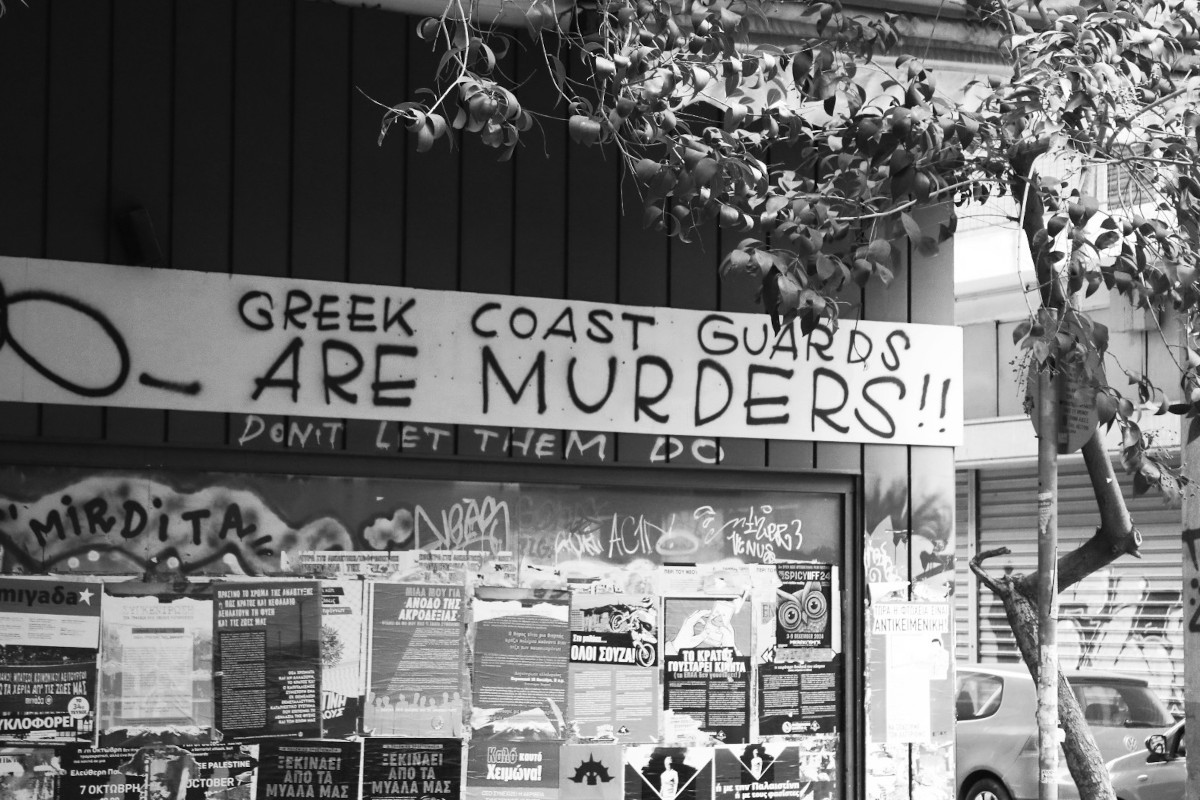
Greece: Illegal, violent deportations: the heavy toll of seeking asylum in Europe
Asylum seekers in Lesvos report that violent pushbacks by masked Greek coastguard forces persist, involving physical abuse, strip searches, theft, and potential use of migrants as auxiliaries.
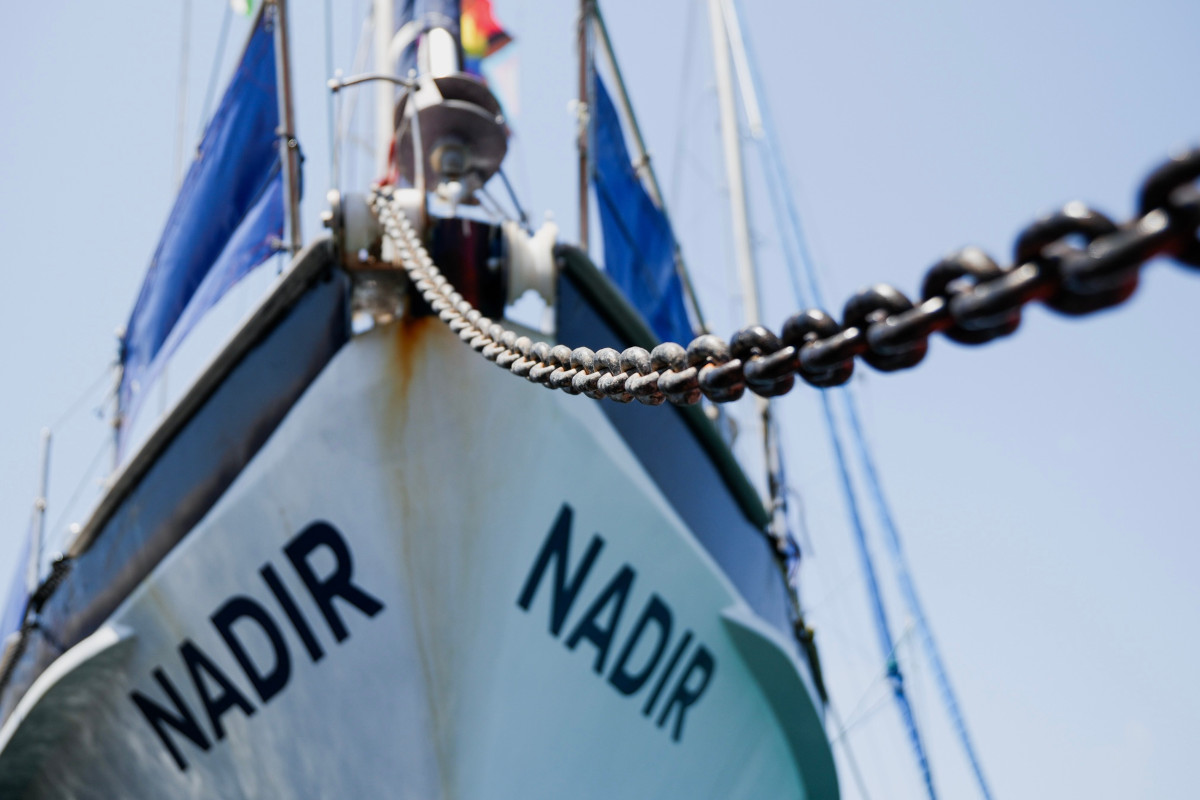
Italy's "systematic obstruction" of civilian search and rescue missions must end
A statement signed by 32 organisations from across Europe calls for an immediate halt to the systematic obstruction of non-governmental search and rescue (SAR) efforts by the Italian state. In the past month alone, NGO vessels have been detained three times due to legal restrictions based on allegations under the “Piantedosi decree" (named after the current interior minister). One vessel, Nadir, operated by the organisation RESQSHIP, was detained twice in a row. Deliberately keeping non-governmental search and rescue organisations away from the Central Mediterranean causes countless more deaths at sea on one of the deadliest flight routes worldwide.

Spotted an error? If you've spotted a problem with this page, just click once to let us know.